Blog

  • AI for Carbon Accounting, EPR, ESG, and Waste: From Sustainability Data to Actionable Reports

    AI for Carbon Accounting, EPR, ESG, and Waste: From Sustainability Data to Actionable Reports

    Why AI Is Becoming Important in Sustainability

    Sustainability teams are expected to manage more data than ever: carbon emissions, waste volumes, recycling outcomes, EPR obligations, supplier evidence, training records, ESG metrics, certification documents, and investor-ready reports. Many teams still collect this information manually through emails, spreadsheets, PDFs, and disconnected systems.

    AI can reduce that burden by helping teams:

    • Collect data through surveys.
    • Classify records and emissions sources.
    • Flag incomplete or unusual data.
    • Summarize trends.
    • Generate report narratives.
    • Support decision-making with recommendations.
    • Make dashboards easier to interpret.

    The most valuable AI use cases are tied to real operational data, not generic sustainability language.

    AI in Carbon Accounting: Sanaterra

    Sanaterra, powered by RecyGlo, is positioned as an AI-powered carbon footprint platform. Its service materials focus on turning carbon compliance into competitive advantage by simplifying, automating, and strengthening reporting.

    Sanaterra supports:

    • Scope 1, 2, and 3 emissions tracking.
    • Automated data collection through surveys.
    • One-click survey deployment to departments.
    • Real-time validation checks aligned with the GHG Protocol.
    • Supporting document uploads.
    • Admin review and approval.
    • Entity-level emissions visibility.
    • Target setting for total emissions and emissions intensity.
    • Downloadable report generation.
    • AI-generated insights and recommendations.
    • Technical expert verification in enterprise reporting.

    This is a practical AI use case because it starts with structured data collection and ends with a report the company can review, download, and use.

    AI in ESG Reporting

    RecyGlo’s MSME ESG ecosystem deck describes AI-enhanced narrative building for ESG reporting. The platform helps organizations manage and report their sustainability story with more integrity and confidence.

    The deck also describes a new standard for ESG reporting that is AI-powered and blockchain-secured. AI crafts clearer report narratives, while blockchain is positioned as a way to keep data tamper-proof and auditable. The ESG platform also uses automated survey systems to gather social and governance data and align reporting with frameworks such as GRI and SASB.

    For ESG teams, this means AI can help transform data into a coherent report. But the report still needs governance. Human teams must review metrics, assumptions, evidence, and claims before publication.

    AI in EPR and Waste Management

    Waste management is a data-heavy workflow. Companies need to know what material was collected, where it came from, how it was categorized, where it went, and what the outcome was. EPR adds another layer: regulatory and client reporting.

    RecyGlo’s EPR & Waste Management platform supports automated waste tracking, emission monitoring, instant reporting, real-time dashboards, waste collection and category tables, client management, facilities, pickup locations, vehicles, and report generation.

    AI and automation can support:

    • Faster waste data entry and review.
    • Better visibility over material categories.
    • Emission monitoring from waste activity.
    • Operational dashboards for clients and partners.
    • Report generation for EPR and compliance.
    • Data exports for carbon and ESG platforms.

    The Wongpanit case study shows why this matters. RecyGlo built a white-label platform for Wongpanit to replace fragmented manual records with a centralized digital reporting system, supporting EPR compliance, operational monitoring, and traceability across the recycling value chain.

    AI, MRV, and Carbon Credit Readiness

    RecyGlo’s EPR-to-Net-Zero and annual report materials connect waste data with MRV and carbon credit tokenisation. The logic is straightforward:

    1. Waste and recycling data is tracked through a platform.
    2. Carbon emissions saved are calculated.
    3. Data is verified through MRV systems.
    4. Verified reductions may become carbon credits.
    5. Credits can potentially be tokenized, traded, or sold in voluntary markets.

    RecyGlo’s MOU with ERTH Ventures for the Wongpanit Waste Management MRV and Carbon Credit Tokenisation Project is presented as a step toward converting verified environmental impact data into traceable carbon credit assets.

    AI can support this process, but credibility depends on measurement, reporting, verification, recognized methodologies, and traceable records. Without reliable data, AI cannot create trustworthy environmental assets.

    The Responsible Way to Use AI in Sustainability

    AI should support sustainability teams, not replace accountability. A responsible AI-enabled sustainability system should have:

    • Clear source data.
    • Defined calculation methods.
    • Human review and approval.
    • Evidence storage.
    • Role-based access.
    • Transparent reporting periods.
    • Exportable reports.
    • Consistent material and emissions categories.
    • Audit and verification support where needed.

    RecyGlo’s materials emphasize this direction through automated surveys, admin review, validation, expert verification, dashboards, and MRV-grade systems.

    What Businesses Can Do Now

    Companies that want to use AI for sustainability should start with data readiness:

    • Run a waste audit to map materials and losses.
    • Digitize waste collection, recycling, disposal, and secure destruction data.
    • Set up carbon accounting for Scope 1, 2, and 3.
    • Use surveys to collect department-level data.
    • Connect waste data to ESG and carbon reporting.
    • Define report owners and review workflows.
    • Use AI for insights, narratives, anomaly checks, and recommendations.
    • Keep humans responsible for final claims and compliance decisions.

    RecyGlo’s platform ecosystem is built around this sequence: collect better data, digitize operations, automate reporting, verify outcomes, and turn sustainability into business value.

    FAQ

    How can AI help carbon accounting?

    AI can support carbon accounting by helping collect data, classify emissions sources, validate records, summarize emissions trends, generate reports, and produce recommendations.

    How does RecyGlo use AI in carbon reporting?

    RecyGlo’s Sanaterra platform includes automated surveys, real-time validation, target setting, report generation, AI-generated insights, and technical expert verification for enterprise reports.

    Can AI help with ESG reporting?

    Yes. AI can help build clearer ESG narratives, summarize data, support surveys, and align report content with frameworks. Human review is still needed for final disclosures.

    Can AI create carbon credits from waste data?

    AI alone cannot create credible carbon credits. Carbon credit readiness requires measured data, recognized methodology, MRV, verification, and traceability. AI can support the workflow, but verification is essential.
  • ESG Reporting: How Waste, Carbon, and Compliance Data Become Investor-Ready Sustainability Evidence

    ESG Reporting: How Waste, Carbon, and Compliance Data Become Investor-Ready Sustainability Evidence

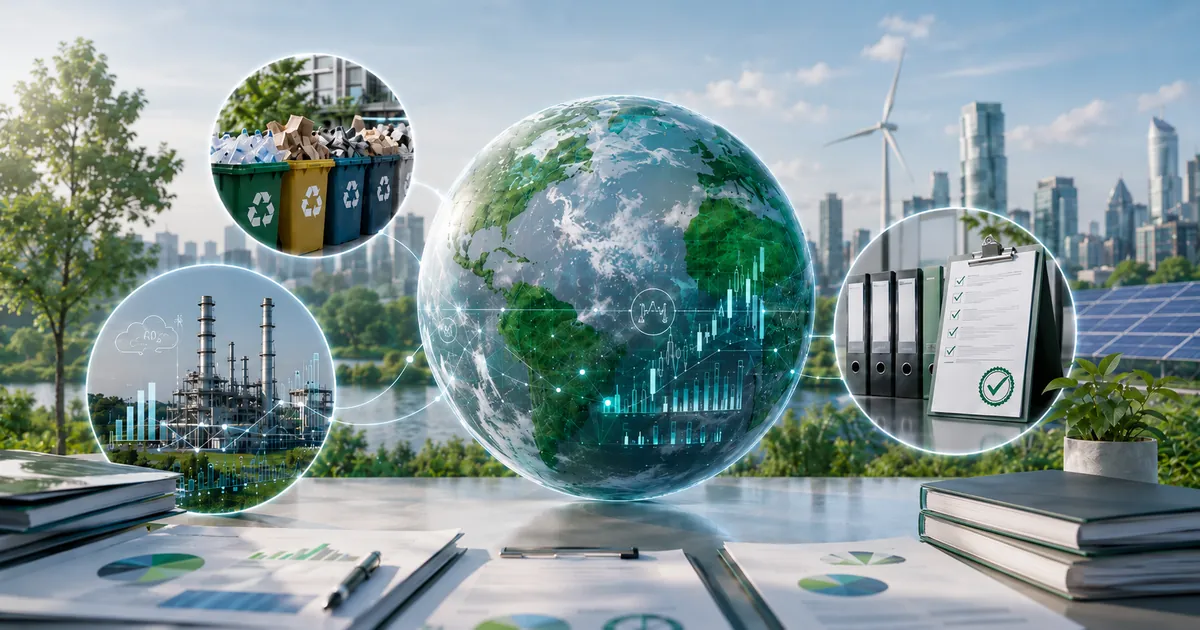
    ESG reporting concept with waste recycling, carbon data, compliance documents, and investor-ready sustainability evidence

    RecyGlo’s ESG ecosystem combines ESG software, waste management software, carbon accounting, waste audits, sustainability training, certification support, and compliance services. Its updated MSME materials position RecyGlo as a green finance facilitation partner that helps MSMEs become loan-ready, bankable, and compliant for programs such as SME Green Productivity and the BCG Economy.

    Why ESG Reporting Is Becoming a Data Problem

    ESG reporting used to be mostly narrative. Companies described sustainability activities, social programs, and governance policies. Today, stakeholders expect evidence. They want to see data, controls, targets, standards, and improvement over time.

    For many businesses, the problem is not a lack of sustainability activity. The problem is that the data is scattered:

    • Waste data sits with facilities or vendors.
    • Carbon data sits across departments and utility bills.
    • Social and governance data sits with HR, compliance, procurement, or leadership.
    • Evidence sits inside PDFs, invoices, photos, certificates, and emails.
    • Reports are written after the year ends, when the data should already have been tracked.

    RecyGlo’s platform approach addresses that problem by centralizing ESG, waste, and carbon data in digital workflows.

    What RecyGlo’s ESG Platform Supports

    According to RecyGlo’s company profile and MSME ESG ecosystem deck, the ESG software helps organizations:

    • Track environmental, social, and governance metrics.
    • Monitor compliance with ESG standards and global regulations.
    • Create sustainability reports for stakeholders.
    • Align reports with frameworks such as GRI and SASB, with options for additional frameworks.
    • Use automated survey systems to collect social and governance data.
    • Use AI to craft clear report narratives.
    • Use blockchain-secured records for auditable data integrity in the ESG ecosystem positioning.
    • Manage data across entities, depending on package level.
    • Integrate Scope 1, 2, and 3 carbon calculations.
    • Access verification, audit support, and consulting or training.

    The goal is to make ESG reporting less manual, more consistent, and easier to connect with business decisions.

    Waste Data Is Core ESG Evidence

    Waste data is one of the most practical entry points for ESG reporting because it is operational, measurable, and directly linked to cost, compliance, and environmental performance.

    RecyGlo’s waste services and platform can help businesses report:

    • Waste generated by material type.
    • Waste collected, recycled, composted, treated, or disposed.
    • Hazardous and non-hazardous waste.
    • E-waste and secure destruction volumes.
    • Waste segregation performance.
    • Recycling outcomes.
    • Waste management cost and operational efficiency.
    • Carbon avoidance or emissions where methodology supports it.

    In its 2025 annual report materials, RecyGlo states that it managed or collected over 100,000 tons of waste and delivered around 52,488 tCO2e of carbon avoidance in 2025. It also reports that 100% of managed waste streams were digitally tracked from source to processing. Those are the kinds of data points that turn ESG reporting from a claim into evidence.

    Carbon Data Strengthens ESG Reporting

    Carbon accounting is one of the most visible parts of environmental reporting. RecyGlo’s Sanaterra platform supports automated Scope 1, 2, and 3 tracking, survey-based data collection, emissions target setting, downloadable reports, and AI-generated insights.

    This matters for ESG because investors, customers, and regulators often want to see:

    • Scope 1, 2, and 3 emissions.
    • Emission reduction targets.
    • Energy consumption and energy-related emissions.
    • Progress against targets.
    • Data quality and methodology.
    • Climate risks and opportunities.
    • How carbon data connects to waste, logistics, operations, and procurement.

    RecyGlo’s annual report materials state that the carbon platform supports GHG Protocol-aligned, audit-ready reporting and alignment with ISO 14001, ISO 9001, and ISO 50001.

    ESG Reporting for MSMEs and Green Finance

    One of the clearest updates in the supplied service files is RecyGlo’s ESG ecosystem for MSMEs. The deck positions RecyGlo as a green finance facilitation partner for MSMEs, helping them become loan-ready, bankable, and compliant for programs like SME Green Productivity and the BCG Economy.

    This is important because many MSMEs want access to green loans or sustainability-linked opportunities but do not yet have the ESG documentation, carbon data, waste tracking, or compliance evidence lenders and partners may expect.

    RecyGlo’s MSME framework includes:

    • ESG reporting platform access.
    • GHG accounting platform.
    • Waste tracking and audit dashboards.
    • Data integration and MRV systems.
    • Carbon accounting with Scope 1, 2, and 3 calculations.
    • Automated regulatory checks.
    • Basic, professional, and enterprise reporting maturity levels.
    • Consulting, training, verification, audit, and assurance support depending on package.

    This reframes ESG from a cost burden into a funded business opportunity with measurable impact.

    Compliance and Certification Support

    RecyGlo’s updated service document lists certification and compliance support as a core service area. RecyGlo assists with environmental compliance documentation, sustainability certification support, and waste reporting for regulatory authorities.

    The company profile also lists support areas including B Corp, GRI, SASB, TCFD, SBTi, sustainability reporting, ISO 14001, ISO 45001, ISO 50001, LEED, UN Global Compact, and Thailand Greenhouse Gas Management Organization references.

    For businesses, the practical benefit is credibility. Better documentation reduces non-compliance risk and helps partners, investors, and customers trust ESG claims.

    How RecyGlo Supports the ESG Journey

    RecyGlo’s ESG support is not only software. The supplied service files show a wider operating model:

    • Waste audits to map waste streams and identify material losses.
    • B2B waste management for collection, transportation, disposal, segregation, and recycling.
    • Sustainability training to build internal awareness and implementation capacity.
    • Sanaterra carbon accounting for emissions tracking and reporting.
    • ESG software for metrics, compliance monitoring, and sustainability reporting.
    • Waste management software for real-time tracking, data analytics, and reporting tools.
    • E-waste secure destruction and confidential document destruction.
    • Reporting, certification, accreditation, and compliance support.

    This makes ESG reporting more practical because the report is built from real operational workflows.

    FAQ

    What is ESG reporting?

    ESG reporting is the disclosure of environmental, social, and governance performance, risks, policies, metrics, and targets to stakeholders such as investors, lenders, customers, regulators, and employees.

    Why is waste data important for ESG reporting?

    Waste data supports environmental reporting, circular economy claims, EPR compliance, carbon accounting, cost reduction, and operational transparency.

    How does RecyGlo help MSMEs with ESG?

    RecyGlo helps MSMEs become loan-ready, bankable, and compliant by providing ESG reporting, carbon accounting, waste tracking, audit dashboards, training, consulting, and documentation support.

    What frameworks can RecyGlo support?

    The supplied materials reference GRI, SASB, TCFD, SBTi, ISO 14001, ISO 45001, ISO 50001, LEED, B Corp, UN Global Compact, and related sustainability and compliance pathways.

  • EPR Waste Management Platform: Digital Tracking, Emission Monitoring, and Instant Reporting for Businesses

    EPR Waste Management Platform: Digital Tracking, Emission Monitoring, and Instant Reporting for Businesses

    What Is EPR?

    EPR stands for Extended Producer Responsibility. It is a policy and business framework that extends a producer’s responsibility beyond product sale and into collection, recovery, recycling, disposal, reporting, or financing at end of life.

    For businesses, EPR changes waste from a back-office disposal issue into a strategic data issue. Companies must understand what they place on the market, what materials are involved, how those materials are collected or recovered, and how to document performance for regulators, customers, partners, and internal ESG teams.

    Why Waste Management Data Is the Foundation of EPR

    EPR reporting cannot be credible without operational waste data. A company may know how much packaging it purchased, but that does not prove how waste was collected, recycled, treated, or recovered. A recycling company may collect large amounts of material, but without digital records it may struggle to provide reliable reports to international clients.

    RecyGlo’s service materials identify the typical waste management challenges:

    • Compliance pressure from government and clients.
    • No real-time tracking.
    • No carbon tracking.
    • Lack of visibility for operations and partners.
    • Manual collection and reporting that consumes too much time.
    • Fragmented data that makes EPR reporting difficult.

    The solution is a digital waste management system that connects collection, categorization, emissions, reporting, and compliance evidence.

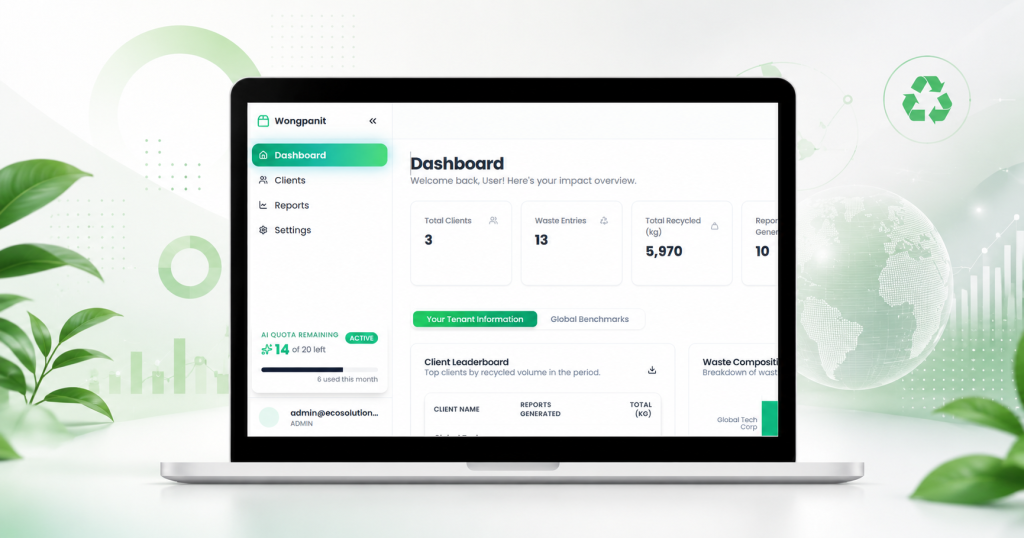
    EPR waste management dashboard on laptop showing waste entries, recycled volume, client reports, and recycling performance data.

    What RecyGlo’s EPR & Waste Management Platform Does

    RecyGlo’s EPR & Waste Management platform enables organizations to track, manage, and report waste streams in compliance with EPR requirements. It provides visibility across material types, volumes, and downstream waste processes, supporting transparent reporting and responsible waste management.

    Based on the supplied EPR Waste Management Platform deck, key features include:

    • Automated waste tracking.
    • Emission monitoring.
    • Instant reporting.
    • Real-time analytics dashboard.
    • Data tables for waste collection and categories.
    • Automated carbon emission reporting.
    • User management for multiple clients.
    • Role-based access for up to 100 users in the white-label platform example.
    • Client management and client details.
    • Waste entries with multiple entry options.
    • Facilities, pickup locations, and vehicles.
    • Report view, download, and report generation.

    The annual report also states that the platform supports ISO 14001 by enabling systematic identification, monitoring, and reporting of waste streams and environmental aspects; ISO 9001 through standardized data collection and documented reporting; and ISO 45001 by improving visibility over waste handling and operational risk areas.

    Case Study: Wongpanit White-Label Platform

    RecyGlo’s service file and annual report describe a partnership with Wongpanit, Thailand’s largest recycling network. Wongpanit’s challenge was fragmented data collection and reporting, difficulty producing reliable reports for international clients, and growing demand for EPR compliance reporting.

    RecyGlo developed a customized EPR & Waste Management Reporting Platform for Wongpanit’s multi-site operations. The platform centralizes data on waste collection, material categorization, and recycling outputs across recycling centers and processing facilities.

    The business value is significant:

    • More accurate, traceable data.
    • Stronger reporting for international partners.
    • Better EPR compliance support.
    • Operational performance monitoring.
    • A platform subscription model Wongpanit can offer to clients.
    • New revenue opportunities through EPR reporting and sustainability services.

    This case study is important because it shows how digital waste reporting can move beyond internal compliance and become a business growth tool.

    EPR, MRV, and Carbon Credits

    RecyGlo’s digital waste management approach can also support future carbon credit opportunities. Through the platform, companies can track waste and recycling data, calculate emissions avoided through improved recovery, verify data through MRV systems, and prepare verified reductions for potential carbon credit development.

    RecyGlo has also worked with ERTH Ventures on the Wongpanit Waste Management MRV and Carbon Credit Tokenisation Project. In this collaboration, RecyGlo supports the digitization of waste collection and processing data through ERP, ESG reporting, and waste management platforms, while ERTH Ventures provides blockchain-enabled MRV and tokenization infrastructure.

    For businesses, the key takeaway is not to jump straight to carbon credits. The first step is credible data. Carbon credit opportunities depend on accurate measurement, transparent reporting, third-party verification, methodology alignment, and traceable waste data.

    What Businesses Should Track

    Businesses preparing for EPR or advanced waste reporting should start with:

    1. Waste source and business unit.
    2. Material category, such as paper, plastic, metal, glass, organic waste, e-waste, multilayer packaging, or cooking oil waste.
    3. Weight or volume.
    4. Collection date and vendor.
    5. Facility, pickup location, and vehicle where relevant.
    6. Recycling, recovery, treatment, disposal, or secure destruction outcome.
    7. Emissions or carbon savings where methodology allows.
    8. Supporting documents, photos, certificates, or reports.
    9. Compliance status by jurisdiction or client requirement.

    RecyGlo’s waste audits can help create the baseline, while the platform turns the baseline into recurring tracking and reports.

    How RecyGlo Supports Businesses

    RecyGlo’s updated service files position the company as an integrated provider across B2B waste management, waste audits, sustainability training, digital sustainability platforms, certification and compliance support, recycling, e-waste secure destruction, confidential document destruction, ESG software, carbon footprint calculation, and reporting support.

    For EPR and waste management, RecyGlo helps businesses:

    • Manage waste collection, transportation, and proper disposal.
    • Improve waste segregation and recycling.
    • Track waste generation through digital tools.
    • Produce reliable reports for internal and external stakeholders.
    • Build EPR reporting workflows.
    • Support zero-waste-to-landfill and circular economy practices.
    • Connect waste data to carbon accounting, ESG reporting, and future MRV opportunities.

    FAQ

    What is EPR in waste management?

    EPR is Extended Producer Responsibility. It makes producers more accountable for products or packaging at end of life, often through collection, recovery, recycling, financing, or reporting obligations.

    Why does EPR need a digital waste platform?

    EPR depends on reliable data. A digital platform helps track waste by material, volume, client, facility, pickup, vendor, recycling outcome, emissions, and reporting period.

    What does RecyGlo’s EPR & Waste Management platform track?

    The platform supports waste entries, collection categories, client management, facilities, pickup locations, vehicles, automated carbon emission reporting, dashboards, and report generation.

    How did RecyGlo support Wongpanit?

    RecyGlo developed a customized EPR & Waste Management Reporting Platform for Wongpanit to centralize waste collection, material categorization, recycling outputs, EPR reporting, operational monitoring, and traceability.

  • Carbon Footprint and Carbon Accounting: How Businesses Can Move From Manual Data to Audit-Ready Reports

    Carbon Footprint and Carbon Accounting: How Businesses Can Move From Manual Data to Audit-Ready Reports

    Carbon footprint and carbon accounting concept with green city, factory, solar panels, wind turbines, and ESG data icons.
    Carbon footprint and carbon accounting help businesses measure emissions, track sustainability performance, and support ESG reporting.

    What Is a Business Carbon Footprint?

     A business carbon footprint is the total greenhouse gas impact created by an organization’s operations and value chain. It can include direct fuel use, purchased electricity, refrigerants, logistics, business travel, purchased goods, waste treatment, packaging, and other upstream or downstream activities.

    For leadership teams, the carbon footprint is a performance signal. It helps answer:

    • Where are our emissions coming from?
    • Which departments, sites, or entities create the biggest impact?
    • Which reduction actions should come first?
    • How can we show credible progress to customers, investors, regulators, and partners?

    The footprint itself is the result. The system behind it is carbon accounting.

    What Is Carbon Accounting?

    Carbon accounting is the process of measuring, organizing, calculating, and reporting greenhouse gas emissions. Most corporate inventories use three scopes:

    • Scope 1: direct emissions from owned or controlled sources.
    • Scope 2: indirect emissions from purchased electricity, steam, heat, or cooling.
    • Scope 3: other value-chain emissions, including purchased goods, transport, waste, travel, and product end-of-life impacts.

    The GHG Protocol treats third-party disposal and treatment of operational waste under Scope 3 Category 5. That means waste data matters. A company needs to know not only how many kilograms or tons of waste it generated, but also the waste type, treatment path, vendor, and destination.

    Why Manual Carbon Reporting Breaks Down

    Many companies begin carbon reporting with spreadsheets. That can work for a very small footprint, but it becomes fragile as soon as the organization has multiple sites, business units, departments, suppliers, or reporting frameworks.

    RecyGlo’s Sanaterra materials identify the common pain points clearly:

    • Endless hours spent manually collecting data across departments.
    • Disconnected data living in silos.
    • Confusion around Scope 1, 2, and 3 emissions.
    • Changing global standards.
    • Fear of inaccurate reporting, failed audits, or non-compliance penalties.
    • Difficulty turning emissions data into strategic planning.

    These are workflow problems, not just calculation problems. A better carbon accounting process should make data collection easier, make review more visible, and keep reporting evidence connected to the final number.

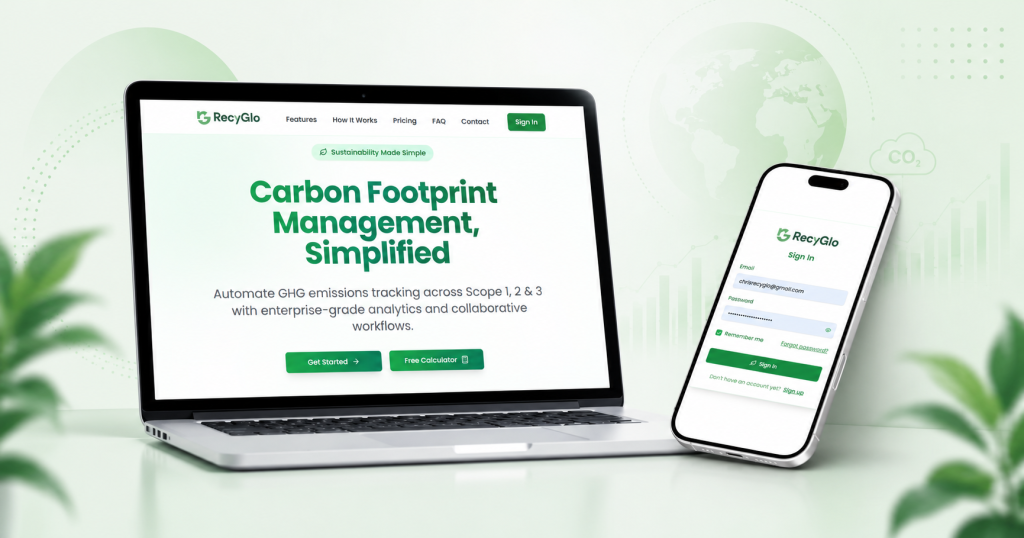
    RecyGlo carbon footprint management software shown on laptop and mobile for tracking GHG emissions and ESG data.

    What RecyGlo’s Sanaterra Adds to Carbon Accounting

    Sanaterra is positioned as an AI-powered carbon footprint platform for future-focused businesses. Its promise is simple: stop chasing carbon data and start leading with it.

    • Automated Scope 1, 2, and 3 emissions tracking.
    • One-click survey collection across departments and entities.
    • Real-time validation checks aligned with the GHG Protocol.
    • Survey tables by sender, recipient, entity, status, emission source, period, method, and emission value.
    • Upload of supporting documents and files.
    • Admin review and approval workflows.
    • Entity pages for organizational branches or business units.
    • Carbon emissions target setting, including total reduction and intensity targets.
    • Report tables and downloadable report generation.
    • Report designs with Scope 1, 2, 3, and total emissions visualized through bar, pie, and comparison charts.
    • AI-generated insights and recommendations, with expert verification available for enterprise reports.

    This turns carbon accounting into a management system rather than a once-a-year spreadsheet exercise.

    How Carbon Accounting Connects to Waste Data

    Waste is one of the clearest places where carbon accounting and operations meet. RecyGlo’s broader service materials show that the company provides B2B waste management, waste audits, waste management software, EPR and waste management reporting, recycling services, and secure e-waste destruction.

    That matters because carbon accounting is stronger when waste data is digital, categorized, and traceable. RecyGlo’s waste services can help companies:

    • Map waste streams by material and source.
    • Track waste generation, collection, recycling, and disposal.
    • Improve segregation and recycling practices.
    • Identify material losses and reduction opportunities.
    • Connect waste data to carbon, ESG, and EPR reporting.

    RecyGlo supported around 52,488 tCO2e of carbon avoidance in 2025 and that 100% of managed waste streams were digitally tracked. These proof points reinforce the business logic: waste data can become carbon data when it is measured, verified, and connected to the right reporting workflow.

    What Businesses Should Track First

    Companies do not need to solve every Scope 3 category immediately. A practical first phase should focus on the data that is already material, available, or required by stakeholders.

    Start with:

    1. Fuel and energy use by site or entity.
    2. Electricity bills and meter data.
    3. Refrigerants and direct emissions sources where relevant.
    4. Waste by material, weight, vendor, and treatment path.
    5. Transport and logistics activity.
    6. Purchased materials and packaging data where material.
    7. Emission factors, assumptions, and reporting boundaries.
    8. Supporting documents for review and audit readiness.

    Sanaterra’s survey model is useful because it distributes data collection to the right people while keeping the carbon team in control of review and reporting.

    How RecyGlo Supports the Full Carbon Workflow

    RecyGlo’s service materials show a broad sustainability stack: waste management, waste auditing, sustainability training, digital sustainability platforms, certification and compliance support, secure e-waste destruction, ESG software, waste management software, carbon footprint calculator, and reporting, certification, accreditation, and compliance support.

    For carbon accounting, that means RecyGlo can support both the data layer and the reporting layer:

    • Waste audits establish reliable baselines.
    • Waste management services generate operational activity data.
    • Sanaterra calculates and reports Scope 1, 2, and 3 emissions.
    • ESG software turns carbon and sustainability data into stakeholder-ready reporting.
    • Training helps teams understand their roles in data collection and reduction.
    • Compliance support helps align outputs with standards and regulatory expectations.

    FAQ

    What is the difference between a carbon footprint and carbon accounting?

    A carbon footprint is the emissions result. Carbon accounting is the process used to collect data, calculate emissions, document assumptions, track targets, and generate reports.

    Does carbon accounting include waste?

    Yes. Waste generated in operations can fall under Scope 3 Category 5 when handled by third parties. Businesses should track waste type, weight, vendor, destination, and treatment path.

    What is Sanaterra?

    Sanaterra is RecyGlo’s AI-powered carbon footprint platform. It supports automated Scope 1, 2, and 3 emissions tracking, one-click surveys, real-time validation, target setting, downloadable reports, and AI-generated insights.

    How does RecyGlo help businesses reduce carbon reporting risk?

    RecyGlo helps businesses collect better operational data, digitize carbon and waste workflows, review supporting documents, generate audit-ready reports, and connect carbon accounting with ESG and compliance reporting.

  • What Is a Waste Audit? A Business Guide to Reducing Waste Costs and Improving ESG Data

    What Is a Waste Audit? A Business Guide to Reducing Waste Costs and Improving ESG Data

    What is a waste audit?

    A waste audit is a structured review of the waste generated by a facility, office, factory, hotel, campus, clinic, or warehouse. It identifies the types and quantities of materials being discarded, where those materials come from, how they are currently handled, and what can realistically be reduced or recovered.

    A simple audit may combine records review, bin mapping, interviews, and a facility walk-through. A more detailed audit physically samples, sorts, and weighs waste by category, such as paper, cardboard, plastic film, rigid plastics, organics, metals, glass, e-waste, hazardous waste, and residual disposal. The output is a data-backed view of your waste stream rather than a guess.

    Why businesses need waste audit data

    Waste costs are often hidden across multiple budgets: hauling, container rental, tipping fees, internal labor, packaging purchases, contamination penalties, and lost recovery value. A waste audit helps bring those costs together so managers can see what is actually driving them.

    •  Cost reduction: right-size bin capacity, reduce unnecessary pickups, and separate valuable recyclable materials.
    • Better recycling performance: identify contamination and improve sorting at the point of disposal.
    • Procurement insight: spot over-ordering, excess packaging, single-use items, and materials that could be redesigned or reused.
    • ESG reporting: create auditable waste data for sustainability reports, carbon accounting, and stakeholder disclosure.
    • Compliance support: document handling practices for regulated streams such as e-waste, batteries, chemicals, clinical waste, oils, or hazardous materials.

    For many organizations, the most useful insight is not only how much waste they generate. It is how much of today’s general waste is actually recoverable, how much recycling is being rejected because of contamination, and which operational changes will create the fastest payback.

    How a business waste audit works

    A credible audit starts with scope and methodology. The audit team should define the site boundary, the streams included, the sampling period, safety requirements, material categories, and the business decisions the audit must support.

    The first step is usually a records review. This includes waste invoices, service frequency, container sizes, disposal routes, tipping fees, recycling revenue, internal labor, and procurement records for materials that later appear in waste. Next, auditors walk the site to understand how waste is generated and handled in offices, production areas, canteens, loading bays, guest areas, laboratories, storage rooms, or other relevant zones.

    For a detailed sort audit, representative waste samples are collected, separated into predefined categories, weighed, and recorded. The results are then validated against available records and annualized where appropriate. A strong report will also disclose limitations, anomalies, or unusual conditions that may affect interpretation.

    What should be included in the final report?

    A useful waste audit should end with a management pack, not just a pie chart. The report should show what was measured, how it was measured, what it means, and what to do next.

    • Waste stream profile by material, source area, quantity, and destination.
    • Diversion rate, capture rate, contamination rate, and landfill or disposal tonnage.
    • Cost baseline covering hauling, disposal, pulls, internal handling, and recovery value.
    • Priority actions, from quick wins to longer-term operational or procurement changes.
    • Monthly KPIs for tracking progress after the audit.
    • ESG and carbon-accounting mapping where relevant.

    Waste audits and ESG reporting

    Waste data is increasingly important for sustainability disclosure. Frameworks such as GRI 306 ask organizations to explain how waste is managed and to disclose relevant waste-related impacts and outcomes. The GHG Protocol also treats operational waste under Scope 3 Category 5, which means treatment-path data can support stronger carbon inventories.

    This is where waste audits connect directly to RecyGlo’s broader value proposition. RecyGlo combines professional waste audit services with waste management, recycling, reporting, compliance support, ESG data analytics, and carbon accounting. That makes the audit the starting point for an ongoing waste intelligence system: diagnose the problem, implement the actions, monitor KPIs, and generate reporting-ready evidence.

    When should your business run a waste audit?

    A business should consider a waste audit when waste bills are rising, recycling performance is unclear, contamination is recurring, a new ESG report is due, a site is preparing for certification, a procurement review is underway, or leadership wants a credible waste-reduction target.

    A one-time audit can reveal quick wins. Routine audits turn those findings into continuous improvement. For multi-site businesses across Asia-Pacific, regular waste data also helps compare locations, identify anomalies, and standardize sustainability reporting across markets.

    Ready to turn waste into business intelligence?

    If your company is still managing waste through invoices and assumptions, a waste audit is the practical place to start. RecyGlo helps businesses measure what is really happening on-site, reduce avoidable waste, improve recycling and recovery, and turn waste data into ESG-ready insights.

    Book a waste audit with RecyGlo to understand what your business can reduce, recover, and report with confidence.

    FAQ

    How often should a business do a waste audit?

    Many businesses start with a baseline audit and repeat the process annually or quarterly, especially when waste volumes, vendors, operations, or ESG reporting requirements change.

    Is a waste audit only for large companies?

    No. Offices, factories, hotels, schools, clinics, warehouses, and retail sites can all benefit. The scope should match the size, risk, and complexity of the site.

    What is the difference between a waste audit and regular waste collection data?

    Collection data shows what was hauled away. A waste audit shows what the material actually was, where it came from, whether it was contaminated, and what decisions can improve performance.

  • RecyGlo Publishes Report on Thailand’s Battle With Climate Change

    RecyGlo Publishes Report on Thailand’s Battle With Climate Change

    In July 2024, RecyGlo published a report on Thailand’s battle with climate change that highlights about the significant challenges driven by the aftermath of climate change in Thailand. This report delves into how extreme levels of greenhouse gas emissions in Thailand have been a result of the growing population in Thailand with its rapid economic expansion. The report further highlights the urgent need for comprehensive mitigation and adaptation strategies.

    Climate Change Impacts on Thailand

    Climate change presents significant challenges globally, and Thailand is no exception as it faces escalating risks from climate hazards such as heavy rainfall, floods, droughts, and sea level rise. Given these challenges, it is essential to address Thailand’s environmental impact and implement proper strategies for mitigation and adaptation to combat the effects of climate change.

    Thailand’s tropical climate has seen an increasing temperature and fluctuating precipitation patterns over recent decades. The report highlights some of the issues Thailand has been facing:

    1. Rising Temperatures: From 2011 to 2021, Thailand experienced significant temperature increases, with the highest temperature recorded in April 2016 at 44.6°C in Mae Hong Son. The heat waves lead to serious health risks such as heat stress and respiratory diseases, impacting public health significantly in Thailand.

    2. Sea Level Rise: Rising sea level has posed a major threat to coastal areas, especially in the Bangkok region which is built on a low-lying plain and hence faces serious risks of being submerged by 2030, if proper action is not taken.

    3. Air Quality Degradation: The degradation of air quality is a result of climate change since rising temperatures raise the level of particulate matter and ground-level ozone. This deterioration in air quality has been exacerbating health problems and adding to the global warming challenge.

    Socioeconomic Impacts The report covers the impacts of climate change in Thailand which is profound, affecting myriad sectors:

    1. Agriculture: Altered precipitation and unstable temperature patterns have been threatening crop yields and food security, impacting the livelihoods of farmers and rural communities in Thailand.

    2. Public Health: Increased heatwaves and deteriorating air quality are leading to respiratory and heat-related illnesses, posing significant health risks.

    3. Infrastructure: Floods and rising sea levels have damaged infrastructure, leading to economic losses and displacement of communities in Thailand.

    To understand the impacts in more detail and learn about how we can take mitigation and adaptation strategies, read our new report THAILAND’S BATTLE WITH CLIMATE CHANGE.

  • Thailand’s Sustainable Future: The Significance of Renewable Energy

    Thailand’s Sustainable Future: The Significance of Renewable Energy

    Thailand’s road to sustainability requires a robust strategy to reach its goal by 2030 and plan for a greener future ahead. The use of renewable energy hence is crucial in lowering carbon emissions, strengthing energy security, and ensuring a smooth transition to a circular economy with greener alternatives. The Thai government has a solid framework called the Power Development Plan (PDP) scheduled to be implemented for the period 2024 to 2037. According to this plan, the ideal target set covers that 30% of the total power generated in Thailand must be renewable energy by 2030. A swift adherence to this framework and target could guarantee better results for Thailand’s ambitious goal of reaching carbon neutrality by 2050 and a net-zero target by 2065.

    Making the Switch to Renewable Energy

    The main renewable energy sources that are now under development include hydropower, biomass, solar, and wind. Thailand’s abundant solar resources position it as a nation with significant potential for solar energy development and the government has incentivized the use of solar power through tax incentives and financial support of projects. For example, the Electricity Generating Authority of Thailand (Egat), is initiating 15 floating solar farm projects that hold a capacity of 2,750MW, as reported by Bangkok Post.

    Thailand’s geography is abundant with alternative resources for energy production, albeit at a lower capacity. Wind power projects are possible in coastal and highland regions and small and micro-hydropower system projects are possible at rural locations too. Besides this, as the majority of Thai people are employed in the agriculture sector, biomass and biogas are the most popular alternative energy as they provide a clean energy source and a sustainable method of managing agricultural waste but by 2037, it is estimated that more than 30% of the alternative energy in Thailand will be dominated by solar energy.

    Thailand’s shift to renewable energy will result in

    1. Expand job market opportunities
    2. Create a positive environmental impact
    3. Social Development

  • Understanding the importance of circular economy in Thailand

    Understanding the importance of circular economy in Thailand

    The “Take-Make-Waste” system normally endorsed by Thailand’s linear economy has been reprimanded recently due to its role in promoting climatic hazards. Under this production process, resources that are not utilized during the manufacturing period are discarded as waste and even after the product is manufactured, waste is produced from the packaging and eventually, the end of a product’s usable life signals its call to further become a waste.

    The Take-Make-Waste model has shown to be unsustainable as it has been exacerbating environmental and climate issues in today’s expanding economy of over-consumption where high waste generation and depletion of natural resources have significantly been contributing to climate change, and accelerating the scarcity of resources.

    The Circular Economy: A sustainable Solution

    The concept of Circular Economy is termed the “take-use-return” model and it is uniquely designed to lower production costs, increase market competitiveness and thus profitability while substantially reducing emissions. This relatively new economic model is designed to maintain the regeneration of the natural environment while using resources and simultaneously reducing pollution.

    The importance of a circular economy lies beyond its environmental benefits; it directs a future full of innovative opportunities that can boost profits for businesses. In Thailand, industries have taken an ambitious goal of integrating a circular economy as part of their reformative approach to a better viable economy. Reports by Thailand Investment Review have illustrated that the quantity of industrial waste being recycled was extremely low in Thailand. Their 2018 report highlighted that Thailand was able to recycle only a third of its total waste of 22 million tons that was produced.

    While the economic growth in Thailand has been sought after by the population and the government, the unmanaged growth has somewhat victimized the environment to face the repercussions. A report by Thailand Investment Review illustrated that high economic growth has been directly related to both high waste production and waste management gaps. In fact, in 2018, Thailand produced 27 million tons of household waste out of which only 25% of the total plastic waste was recycled by the government, highlighting the urgent need for action by the government.

    Thailand’s Circular Economy Initiatives 2024

    Currently, the initiatives related to CE are mainly handled by private and public sectors through voluntary engagement. While the government of Thailand has shown growing interest and dedication to sustainability development more policies are needed to bring these dynamic changes. One of the longest commitments is to the Sufficiency Economy Philosophy (SEP) introduced by the late King Bhumi which acts as the baseline for Thailand’s goal towards sustainability. The SEP covers three areas of moderation, reasonableness, and prudence to boost Thailand’s goal of achieving the 2030 Agenda for Sustainable Development and the 20-year National Strategy Framework and 5-year National Economic and Development Plan.

    The Thai government’s current stance on adopting CE is accelerated through its Bio-Circular-Green (BCG) economic model under which these initiatives are included:
    1. Plastic Waste Management: Thailand is one of the biggest markets for plastic usage with an estimated amount of 2 million tons of plastic waste generated per year. The government is encouraging the use of biodegradable plastics and the promotion of recycling under the Extended Producer Responsibility (EPR) framework.

    2. Food Waste Reduction: The Thai government is promoting food waste management through better practices, and awareness campaigns.

    3. Legislation and Policies: The Thai government is creating a legal framework to promote a circular economy like promoting green procurement and establishing certifications and proper standards for circular products.