
Why AI Is Becoming Important in Sustainability
Sustainability teams are expected to manage more data than ever: carbon emissions, waste volumes, recycling outcomes, EPR obligations, supplier evidence, training records, ESG metrics, certification documents, and investor-ready reports. Many teams still collect this information manually through emails, spreadsheets, PDFs, and disconnected systems.
AI can reduce that burden by helping teams:
- Collect data through surveys.
- Classify records and emissions sources.
- Flag incomplete or unusual data.
- Summarize trends.
- Generate report narratives.
- Support decision-making with recommendations.
- Make dashboards easier to interpret.
The most valuable AI use cases are tied to real operational data, not generic sustainability language.
AI in Carbon Accounting: Sanaterra
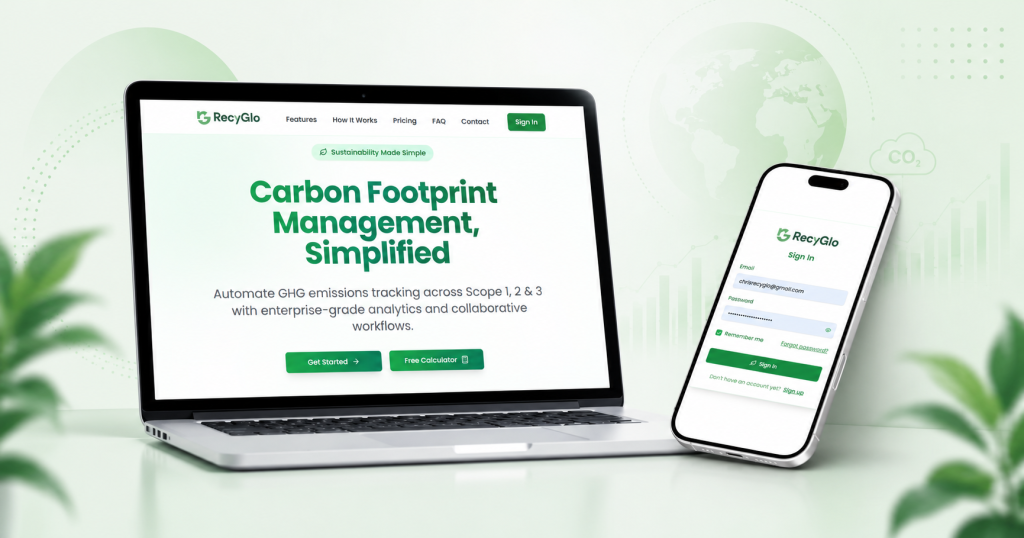
Sanaterra, powered by RecyGlo, is positioned as an AI-powered carbon footprint platform. Its service materials focus on turning carbon compliance into competitive advantage by simplifying, automating, and strengthening reporting.
Sanaterra supports:
- Scope 1, 2, and 3 emissions tracking.
- Automated data collection through surveys.
- One-click survey deployment to departments.
- Real-time validation checks aligned with the GHG Protocol.
- Supporting document uploads.
- Admin review and approval.
- Entity-level emissions visibility.
- Target setting for total emissions and emissions intensity.
- Downloadable report generation.
- AI-generated insights and recommendations.
- Technical expert verification in enterprise reporting.
This is a practical AI use case because it starts with structured data collection and ends with a report the company can review, download, and use.
AI in ESG Reporting
RecyGlo’s MSME ESG ecosystem deck describes AI-enhanced narrative building for ESG reporting. The platform helps organizations manage and report their sustainability story with more integrity and confidence.
The deck also describes a new standard for ESG reporting that is AI-powered and blockchain-secured. AI crafts clearer report narratives, while blockchain is positioned as a way to keep data tamper-proof and auditable. The ESG platform also uses automated survey systems to gather social and governance data and align reporting with frameworks such as GRI and SASB.
For ESG teams, this means AI can help transform data into a coherent report. But the report still needs governance. Human teams must review metrics, assumptions, evidence, and claims before publication.
AI in EPR and Waste Management
Waste management is a data-heavy workflow. Companies need to know what material was collected, where it came from, how it was categorized, where it went, and what the outcome was. EPR adds another layer: regulatory and client reporting.
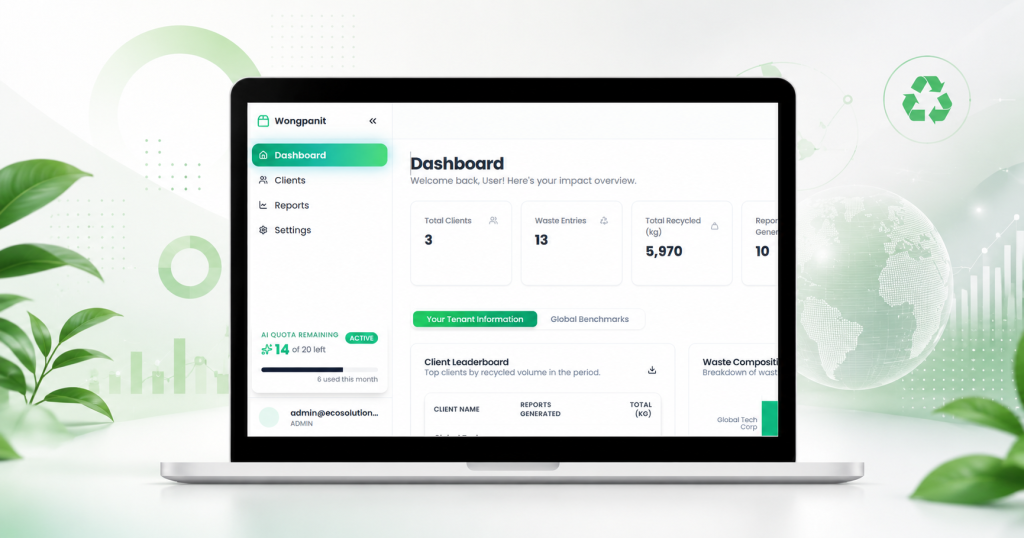
RecyGlo’s EPR & Waste Management platform supports automated waste tracking, emission monitoring, instant reporting, real-time dashboards, waste collection and category tables, client management, facilities, pickup locations, vehicles, and report generation.
AI and automation can support:
- Faster waste data entry and review.
- Better visibility over material categories.
- Emission monitoring from waste activity.
- Operational dashboards for clients and partners.
- Report generation for EPR and compliance.
- Data exports for carbon and ESG platforms.
The Wongpanit case study shows why this matters. RecyGlo built a white-label platform for Wongpanit to replace fragmented manual records with a centralized digital reporting system, supporting EPR compliance, operational monitoring, and traceability across the recycling value chain.
AI, MRV, and Carbon Credit Readiness
RecyGlo’s EPR-to-Net-Zero and annual report materials connect waste data with MRV and carbon credit tokenisation. The logic is straightforward:
- Waste and recycling data is tracked through a platform.
- Carbon emissions saved are calculated.
- Data is verified through MRV systems.
- Verified reductions may become carbon credits.
- Credits can potentially be tokenized, traded, or sold in voluntary markets.
RecyGlo’s MOU with ERTH Ventures for the Wongpanit Waste Management MRV and Carbon Credit Tokenisation Project is presented as a step toward converting verified environmental impact data into traceable carbon credit assets.
AI can support this process, but credibility depends on measurement, reporting, verification, recognized methodologies, and traceable records. Without reliable data, AI cannot create trustworthy environmental assets.
The Responsible Way to Use AI in Sustainability
AI should support sustainability teams, not replace accountability. A responsible AI-enabled sustainability system should have:
- Clear source data.
- Defined calculation methods.
- Human review and approval.
- Evidence storage.
- Role-based access.
- Transparent reporting periods.
- Exportable reports.
- Consistent material and emissions categories.
- Audit and verification support where needed.
RecyGlo’s materials emphasize this direction through automated surveys, admin review, validation, expert verification, dashboards, and MRV-grade systems.
What Businesses Can Do Now
Companies that want to use AI for sustainability should start with data readiness:
- Run a waste audit to map materials and losses.
- Digitize waste collection, recycling, disposal, and secure destruction data.
- Set up carbon accounting for Scope 1, 2, and 3.
- Use surveys to collect department-level data.
- Connect waste data to ESG and carbon reporting.
- Define report owners and review workflows.
- Use AI for insights, narratives, anomaly checks, and recommendations.
- Keep humans responsible for final claims and compliance decisions.
RecyGlo’s platform ecosystem is built around this sequence: collect better data, digitize operations, automate reporting, verify outcomes, and turn sustainability into business value.
FAQ
How can AI help carbon accounting?
AI can support carbon accounting by helping collect data, classify emissions sources, validate records, summarize emissions trends, generate reports, and produce recommendations.
How does RecyGlo use AI in carbon reporting?
RecyGlo’s Sanaterra platform includes automated surveys, real-time validation, target setting, report generation, AI-generated insights, and technical expert verification for enterprise reports.
Can AI help with ESG reporting?
Yes. AI can help build clearer ESG narratives, summarize data, support surveys, and align report content with frameworks. Human review is still needed for final disclosures.
Can AI create carbon credits from waste data?
AI alone cannot create credible carbon credits. Carbon credit readiness requires measured data, recognized methodology, MRV, verification, and traceability. AI can support the workflow, but verification is essential.